Food Delivery App Development in Jordan: A Complete Guide to Building a Talabat-Style Platform
Looking to enter the Jordanian food delivery market? Learn the technical requirements, the 3-app ecosystem, and realistic development costs for building a platform like Talabat in Amman.
Aviniti Team
Published on February 28, 2026
Food Delivery App Development in Jordan: Building the Next Big Platform
The delivery landscape in Jordan has seen a seismic shift over the last few years. While giants like Talabat and Careem Food dominate the headlines, there is a growing niche for hyper-local delivery services, specialized cuisine platforms, and direct-to-consumer apps for large restaurant chains.
If you are an entrepreneur or a business owner in Amman, Irbid, or Aqaba, you aren't just building an app; you are building a complex logistics ecosystem. This guide breaks down everything you need to know about food delivery app development in Jordan, from the technical architecture to the local market costs.
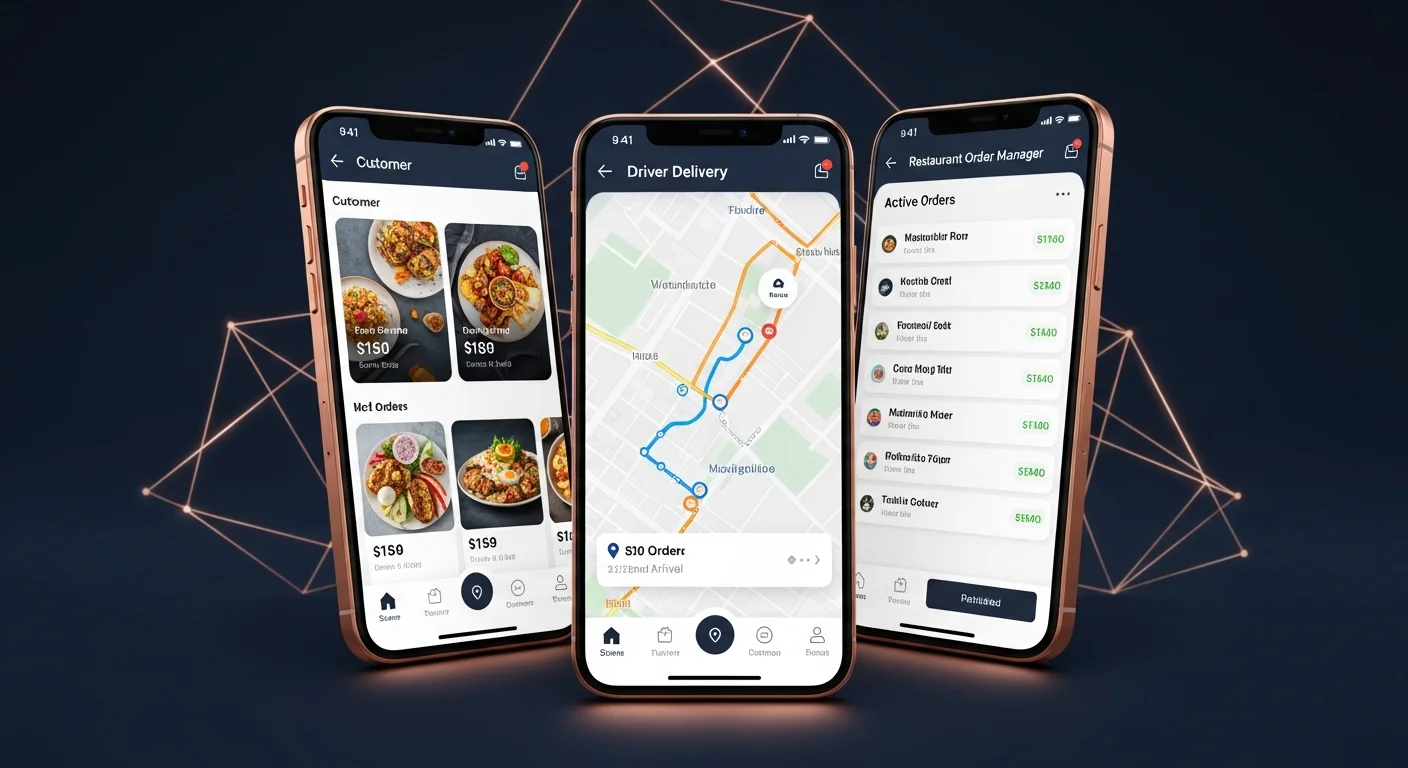
The 3-App Ecosystem: More Than Just a Menu
A common mistake many founders make is thinking they only need one app. In reality, a platform like Talabat consists of four distinct interconnected parts that must communicate in real-time.
1. The Customer App (iOS & Android)
This is your storefront. It needs to be fast, intuitive, and localized. For the Jordanian market, this means supporting both Arabic and English seamlessly and integrating local payment preferences.
- Key Features: Smart search, real-time GPS tracking, multi-address saving, and integrated loyalty programs.
- Local Nuance: Integration with HyperPay or MadfooatCom is essential for local credit/debit card processing.
2. The Vendor (Restaurant) App
Restaurants need a dedicated interface to manage incoming orders. This can be a tablet-based app or a web dashboard.
- Key Features: Order acceptance/rejection, menu management (toggling items out of stock), and performance analytics.
- Local Nuance: Ability to print receipts directly to Bluetooth thermal printers—a staple in Jordanian kitchens.
3. The Driver App
The backbone of your logistics. This app focuses on efficiency and clarity.
- Key Features: Optimized route mapping (Google Maps/Mapbox), earnings tracker, and instant delivery notifications.
- Local Nuance: In Jordan, precise street addressing can be tricky. Features that allow customers to drop a precise pin and drivers to call via the app (masked numbers) are vital.
4. The Admin Dashboard (The Brain)
This is a web-based portal for the business owner to oversee the entire operation. From here, you manage commissions, resolve disputes, and monitor heat maps of active orders.
Custom Build vs. White Label: Which is Right for You?
Choosing how to build your platform depends on your long-term goals. At Aviniti, we often help clients navigate this choice using our AI Analyzer to determine the best market fit.
| Feature | Custom Development | White Label / SaaS |
|---|---|---|
| Ownership | You own 100% of the source code | You pay a recurring license fee |
| Scalability | Unlimited; built for your growth | Limited to the provider's features |
| Initial Cost | Higher ($15,000 - $40,000+) | Lower ($2,000 - $7,000 upfront) |
| Time to Market | 4 - 8 Months | 2 - 4 Weeks |
| Unique Branding | Fully bespoke design | Template-based |
Realistic Costs and Timelines in Jordan
When discussing food delivery app development in Jordan, transparency regarding the budget is crucial. The cost is influenced by the complexity of the features and the seniority of the engineering team.
Estimated Budget Breakdown (JOD/USD)
- MVP (Minimum Viable Product): Focused on core ordering and delivery.
- Cost: 10,000 JOD - 18,000 JOD ($14,000 - $25,000)
- Timeline: 3-4 months
- Advanced Platform: Including AI-driven recommendations, advanced loyalty tiers, and multi-vendor ERP integrations.
- Cost: 25,000 JOD - 45,000+ JOD ($35,000 - $63,000+)
- Timeline: 6-9 months
To get a precise figure based on your specific feature list, you can use the Aviniti Get AI Estimate tool for an instant breakdown.
Key Challenges in the Jordanian Market
Building the software is only half the battle. To succeed in Jordan, your app must solve local operational hurdles:
- The "Cash on Delivery" Culture: While digital payments are growing (thanks to CLIFF and JoMoPay), a significant portion of Jordanians still prefer COD. Your system must have a robust reconciliation module for drivers to hand over cash at the end of shifts.
- Mapping & Geocoding: Jordan’s geography, especially in older parts of Amman, requires high-precision GPS. Integrating the Google Maps API is standard, but optimizing it to reduce API costs while maintaining accuracy is a technical art.
- Peak Hour Scaling: Friday lunches and Ramadan Iftars see massive spikes in traffic. Your backend architecture (ideally hosted on AWS or Azure) must be able to scale automatically to prevent crashes.
How AI is Changing Delivery App Development
At Aviniti, we integrate AI into the very fabric of the apps we build. For a delivery platform, this means:
- Predictive Analytics: Predicting which areas of Amman will have high demand before it happens.
- Dynamic Pricing: Adjusting delivery fees based on weather or traffic conditions.
- Automated Support: Using AI chatbots to handle 80% of common customer queries like "Where is my order?"
Before you write a single line of code, it is vital to validate your business model. Our Idea Lab can help you refine your concept to ensure it meets a real market need in the MENA region.
FAQ: Food Delivery App Development
1. How long does it take to launch a food delivery app in Jordan? A professional, custom-built ecosystem typically takes between 4 to 7 months to develop, test, and launch on the App Store and Google Play.
2. Do I need a trade license to start a delivery app in Amman? Yes. You will need to register a company and obtain specific permits from the Ministry of Digital Economy and Entrepreneurship and potentially the Greater Amman Municipality (GAM) depending on your logistics model.
3. Can I start with just an Android app? While Android has a larger market share in Jordan, the high-spending demographic often uses iOS. We recommend a cross-platform approach (using Flutter or React Native) to target both audiences simultaneously with a single codebase.
4. What are the ongoing costs? Beyond development, you should budget for server hosting, SMS gateways (for OTPs), Map API fees, and ongoing maintenance (usually 15-20% of the initial build cost per year).
Ready to Digitize Your Food Business?
Whether you are a startup aiming to be the next Talabat or a local restaurant chain looking to cut out the middleman, the right technology partner makes all the difference.
- Not sure about the cost? Get an instant AI-powered estimate.
- Want to validate your idea? Visit our Idea Lab.
- Ready to talk strategy? Contact our Amman team today.